
 |
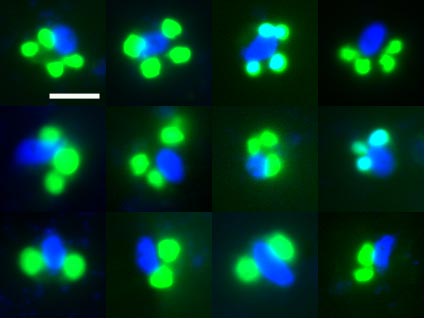
| A collection of rappemonad cells photographed by a high-powered microscope. |
When you hear about researchers discovering an entirely new group of organisms, you picture enterprising scientists diving into uncharted waters, or bushwacking through unexplored jungles.
But what if an entirely new lineage of organisms was living right under our nose, in the fresh and salt water that we see every day? And what if the secret to discovering it wasn’t even in the water itself, but buried in the footnotes of an academic paper?
It may not be the most romantic process, but this was the starting point for a new biological discovery featuring the work of ±«Óătv professor John Archibald and postdoc Eunsoo Kim, both with the Department of Biochemistry and Molecular Biology. They’ve uncovered an entirely new group of algae, distinctly different in its DNA from any other alga that is known to date. Science Daily reported that humans and mushrooms are more closely related to each other than the new algae—dubbed “rappemonadsâ€â€”are to green algae and plants.
Named for Michael Rappé
“Finding a new algal species or genus happens maybe every month, but finding a deeper level novel lineage such as this is pretty rare,†says Dr. Kim. “It maybe only happens every half decade or so.â€
The algae is named after Michael RappĂ©, the first author of a paper published in 1990 containing an unidentified DNA sequence that piqued the ±«Óătv researchers’ curiosity.
“The reality is that in this day and age we’re drowning in DNA sequence data, so often times people are analyzing samples taken from complex environments and have no idea what’s hiding there,†explains Dr. Archibald. “We felt the sequence was kind of anomalous, so in collaboration with Alexandra Worden we started looking at it some more and brainstorming about what it could mean.â€
After acquiring a set of water samples from Dr. Worden at the Monterey Bay Aquarium Research Institute from such locations as the Florida Straits and the Sargasso Sea, the research team developed DNA “probes†designed to detect the sequence. By attaching fluorescent compounds to the probes, Dr. Kim was able to identify individual rappemonad cells under a microscope.
As for what we know about the rappemonads, they’re most likely photosynthetic, appear capable of ‘blooms’ like other algae and exist in both fresh and salt water. Their presence in fresh water was discovered thanks to Thomas Richards at the Natural History Museum in London, England. The Richards lab was simultaneously searching for the same DNA sequence using U.K. fresh water samples. Once the three teams discovered they were tackling the same mystery, they shared their data, demonstrating the algae’s cross-continental reach.
'Big race'
With the results now published in the Proceedings of the National Academy of Sciences, the next step will be for someone to figure out how to bring rappemonds into culture. Dr. Archibald says he’s happy that they were able to make the first steps in this discovery.
“It’s only in the past five or six years that the cost of DNA sequencing has become so low that you can really do culture-independent molecular analyses like this,†he says. “Once they finished the first draft of the human genome, there was all this capacity that basic biologists like us could start to tap into. There’s such a big race to generate new technologies in this field, and basic science is benefitting.â€
LINK: "" in the Proceedings of the National Academy of Sciences