
A new course is providing Indigenous physicians with culturally safe leadership training and support.
Last fall, faculty and early- to mid-career Indigenous physicians from across the country gathered in Membertou First Nation for the inaugural .
Led by the and offered in partnership with ±«Óătv, this initiative is designed to foster Indigenous-led leadership, address anti-Indigenous racism, and build culturally safe learning environments.
Through sharing circles, mentorship, and the guidance of Elders and Knowledge Keepers, participants explored new pathways for personal growth and systemic change. , academic director of Indigenous health, andĚýJohn R. Sylliboy,Ěývice-provost, Indigenous relations, were part of the ±«Óătv team who developed programming for the first iteration of the course, and Elder Ann LaBillois, ±«Óătv’s Elder in residence, helped deliver the first session.
Building a national network
Ěý
NCIME, a partnership between the , the , the , the and the , was formed to implement Indigenous-led work streams that will transform medical education and contribute to the delivery of culturally safe care.
Dr. Young first became involved with NCIME as co-chair of their anti-racism working group, during phase one of their work developing a series of . The organization has since entered a new phase of work and now operates independently. At the request of NCIME, Dr. Young and Sylliboy helped develop the first session material and worked with ±«Óătv’s continuing professional development and medical education (CPDME) office to get the program accredited, ensuring that sessions are recognized by both the Royal College and the College of Family Physicians.
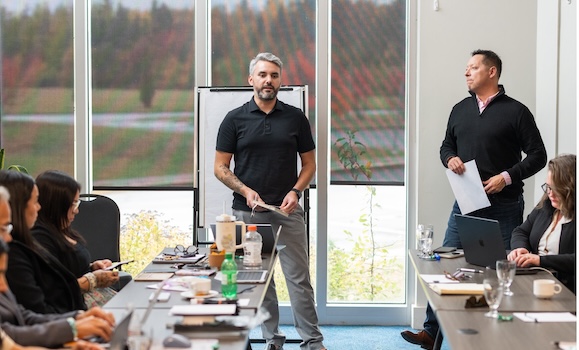
This national collaboration brought together faculty and participants from across Canada, each medical school sending representatives to learn, share, and build a network of Indigenous leaders in academic medicine.
, academic director of Indigenous health in the Faculty of Medicine, represented ±«Óătv and was one of 13 participants from medical schools across Canada.
“There was a wide range of people in the program, including many early‑career physicians like me, as well as others who have been engaged in this work for much longer,” recalls Dr. Blackmore. “It was helpful to learn from those with more experience, while also relating to the challenges and successes of those at a similar career stage.”
The first session in Membertou First Nation was designed to root participants in Indigenous identity and leadership.
The program’s design emphasized Indigenous Ways of Knowing, Doing, and Being, with sharing circles and open dialogue replacing traditional didactic formats.
At the heart of the program was Elder Ann LaBillois, whose teachings and presence set the tone for the entire experience.
LaBillois opened the session by encouraging participants to share gratitude, offering her approach to self-reflection and healing, something that resonated deeply with participants.
“Self‑reflection is so vital, especially for physicians in academic medicine,” says LaBillois. “We accumulate experiences and values, and as we grow, our inner spirit begins to question what we’ve learned. Healing isn’t about fixing something—it’s about facing what’s happening in the moment. Our true medicines come from Mother Earth, and being present helps us listen, understand how to be well, and be our best in a world where racism affects the whole self.”
Filling a leadership gap
Ěý
The Indigenous Faculty Leadership Development Program addresses gaps that mainstream leadership programs often overlook.
“Creating a supportive community is invaluable, especially when facing experiences like anti-Indigenous racism. Mainstream leadership courses don’t address these unique challenges.”
“It’s challenging to be one of few Indigenous leaders in academic spaces,” says Dr. Young. “Creating a supportive community is invaluable, especially when facing experiences like anti-Indigenous racism. Mainstream leadership courses don’t address these unique challenges.”
The program’s emphasis on values-driven leadership—living the seven sacred teachings—offers a pathway for transforming healthcare systems.
“Indigenous leadership cultivates growth and transformation. By embodying these values, leaders can gently influence and transform healthcare systems, making them more inclusive, compassionate, and sustainable for future generations,”ĚýLaBillois reflects.
For the inaugural Indigenous leadership course cohort, the next phase of the program includes monthly online sessions focused on critical race theory, conflict resolution, media training, and integrating ceremony into the workplace. They carry forward the relationships and grounding they built together in Membertou and for many, that sense of connection may prove to be the most transformative outcome of all.
Dr. Blackmore says the power of the program lies in the rare experience of being in community with others doing similar work across the country.
“Sharing knowledge prevents us from reinventing the wheel and helps ensure we’re supporting our students as best we can. Historically, there has been little representation in medical schools, so many of us are the first in our families or communities to enter this space. We don’t always have the professional networks that facilitate navigating academic environments, but programs like this help with that.”
What began as a gathering rooted in identity, reflection, and ceremony has become something larger—a growing circle of Indigenous physicians supporting one another and shaping the future of medical education in ways that honour community, culture, wellness, and self‑determination.
And for institutions like ±«Óătv, this work is only just beginning.
Now read:
Moving away from the white coat: College of Pharmacy updates welcome tradition
Strengthening trust: ±«Óătv’s Indigenous research facilitator connects communities