

Behind the LectureÌępulls back the curtain on some of Dal’s most compelling courses, offering a closer look at the ideas and people that shape them.
A new course offered by ±«Óătv’s Department of Classics is gaining interest among Dal students who are working towards careers in health care and medical fields.Ìę
teaches students the roots and meanings of the Greek and Latin languages to help them better understand medical terminology rather than depending on memorization.
Dr. Christopher Grundke, who teaches the class (first offered in the fall 2025 term), says the course has relevance for a range of students.
“It’s a most natural choice for students preparing for careers in the health professions, who need to use technical medical terminology all day long, every day, in their studies and careers thereafter,†he says.
Students in biology, neuroscience, medical sciences, and medical engineering — all fields that overlap with health professions — could also benefit from this course, he notes.
Also in this series:ÌęExploring Many Canadas: Inside a history course redefining how students see Canada
Deciphering centuries’ old terms
Dr. Grundke says medical professionals in English health settings work with technical jargon that has been developing over hundreds of years. Most of the terms are built using combinations of Greek and Latin roots that form highly specific terms.
Ìę“If one learns both the commonly occurring roots and the rules of the system for building terms, then it's possible to become able to decipher a previously unseen term pretty accurately without needing to consult a dictionary first,†says Dr. Grundke.
It's possible to become able to decipher a previously unseen term pretty accurately without needing to consult a dictionary first.
He raises the example of the term nasopharyngolaryngoscope, which can be divided into its component parts nasopharyng/o/laryng/o/scope. It’s a combination of roots that yields the meaning ‘an instrument for the examination of the larynx and the nasopharynx.’
“All of which one can deduce without ever having met that particular word before,†he says.
Moving away from memorization
Medical Sciences student Connor Bell says what he’s learned in this course has already proven extremely useful, especially in courses like anatomy, physiology, and pharmacology, allowing him to learn how to break words down.
Ìę“It shifted me away from simply memorizing long, complicated terms and helped me see medical terminology as descriptive rather than somethingÌęthat needsÌęto be memorized.â€Ìę
He says recognizing word roots makes it easier to understand new concepts, follow lectures, andÌęretainÌęinformation, making it easier to grasp material without needing to stop and decode longer or more complex terminology.
Fun fact
The longest medical term in general use is cholangiocholecystocholedochectomy, a fourteen-syllable monster term.
It's meaning? The cutting out of the common bile duct and the gallbladder.
"Whether one is a medical professional or not, being able to dissect a term like that is an amusing parlour trick," says Dr. Grundke.
“I was surprised by how universal Latin is in everyday English, not just in medicine. Once you learn it, you start recognizing its influence everywhere, not just in theÌęclassroom.â€Ìę
‘Game changing’ for medical studies
Katherine Watson, a fourth-year Medical Sciences student who took the course last term, says the “building blocks†of the terminology learned will “almost certainly be extremely useful†in her future career as a physician.
She says students learned many root words, prefixes, and suffixes that “make up the words we use to describe our bodies and everything that can go wrong with them.â€
She says the structure of the course made it very easy to succeed and stay engaged.
“It provides a really useful tool kit.â€
It provides a really useful tool kit.
Katherine recommends students take the course earlier than she did, noting her classmates have described it as ‘game changing’ in navigating later anatomy, pathology, and physiology classes.
Gaining the knowledge before working in a clinical environment would also have been helpful, she says, “instead of learning how to refer to each disease and disorder as it presented in front of me.â€
How Classics connects
Dr. Eli Diamond, chair of Classics at Dal, says the development of the course has forged a connection to students who may not have the same interest in studying ancient history, religion, language, philosophy, art, and literature as students majoring in Classics. He says this proves that the ways they teach in Classics connects to other areas of study.
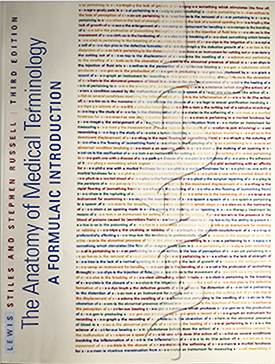 He hopes more students — in other health-related fields, in the Faculty of Arts and Social Sciences, and anyone interested in language-learning and etymology — discover the course.
Shown right: The Anatomy of Medical Terminology, the text used in the class was co-authored by Dr. Stephen Russell, an alum of Dal Classics.
“We figured that one way we could be really useful to a whole different part of the ±«Óătv community is to use our knowledge of ancient languages to help them understand all the medical and scientific terminology they are bombarded with in their training to become health professionals,†Dr. Diamond says.
“We are just hopeful to use this as an example of how learning about the ancient roots of things equips us magnificently for understanding and living in the contemporary world. I look forward in a few years to going into the hospital and meeting a doctor or nurse whose medical work was helped by what this Classics course at ±«Óătv taught them!â€
Interested in this course?ÌęCLAS 2888 – Greek and Latin Terminology for the Medical Sciences will next be offered in the winter 2027 term.