

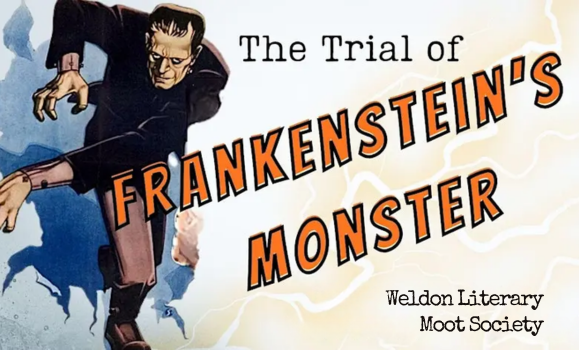
More than 80 people gathered at the Weldon Law Building on March 11 for the 15thÌęannual Weldon Literary Moot, which asked the audience to ponder one key question before rendering a decision in the caseÌęR v. Frankenstein: could they reasonably hold a two-month-old accountable for multiple gruesome murders?
With characters based on Mary Shelley’s 1818 Gothic novelÌęFrankenstein, or The Modern Prometheus, the Trial of Frankenstein versus the Monster concerned the potential criminal activity of the Monster with respect to the deaths of Elizabeth and the De Lacey family — despite being ‘technically’ just two months old at the time.
This year’s dynamic cast included Chief Librarian Mark Lewis as the Monster, Professor Sara Ross as De Lacey, and Assistant Professors Suzie Dunn and Matthew Dylag as Elizabeth and Victor Frankenstein.
Law students Laken Tucker (1L) and Leah Jadd (2L) represented the Crown, while Chaeyon Lee (3L) and Alexander Korski (3L) represented the accused, the Monster. Professor Lucie Guibault led the proceedings as Justice Presiding, while Emily Huang (3L) served as Bailiff.
The annual sketch-comedy moot raises money for theÌę, a non-profit organization that provides university-level humanities education to community members who otherwise would not be able to afford it. This year, the moot raised $4,530.ÌęÌę
What’s at stake?
Ìę
In Ingolstadt, an unusual criminal case has reached the Supreme Literary Moot Court of ±«Óătv. The accused is Victor Frankenstein’s reanimated creation, only two months old, yet towering and charged with multiple murders, including the deaths of Elizabeth and members of the De Lacey family.
The case raises an unusual question:when a scientist creates a powerful being, who is responsible for the harm that follows? The creator or the creation?
The Crown argues that the creature is a calculating and intelligent killer. The defence insists he is simply a neglected and abandoned child. Ultimately, the court will leave the verdict up to the audience to decide who the real monster is.
 Ìę
Ìę
(Re)animated testimony
Ìę
The Crown's first witness, Victor Frankenstein, opened with the admission that he’d created the creature because he longed to be a father. He claimed he tried to love his son and raise him responsibly, but the child was difficult, sneaking out at night, challenging authority, and even going as far as demanding he build him a girlfriend.
Under cross-examination, Frankenstein admitted he never gave the child a proper name and barely searched for him when he ran away. His unusual “scientific†parenting style, not to mention his questionable explanation for how he’d acquired the various body parts, raised serious doubts about his credibility.
Elizabeth, testifying as a ghost (a most unusual legal reality!), said she once loved the creature but suspected he was secretly far more intelligent than he appeared, describing finding advanced texts like the Magna Carta in his room and overhearing him muttering to himself about complex subjects.
However, the defence undermined her testimony after revealing internet searches suggesting she wanted to “get rid of him†and confirming the creature slept on a concrete slab amid harsh conditions, as per the directions in her partner’s parenting handbook.
Sir De Lacey, the blind man who had welcomed the creature into his home, provided a starkly different account. On the stand, he described how the lonely monster helped with chores and became like a son to him. He even named him Jeff.
The Crown, however, questioned how De Lacey could confirm any of this without the use of his sight, and especially given the mysterious disappearance of his family.
When ‘Jeff’ himself testified, he spoke plainly, using repetitive phrases, insisting he was lonely, unloved, and incapable of murder. But under pressure from the Crown on cross-examination, his act collapsed. In a dramatic outburst, the Monster revealed his true intelligence, declaring himself superior to humans and effectively confessing to killing Elizabeth and the De Lacey family.
A shocking outcome
Ìę
In closing, the defence argued that Jeff’s actions were the result of neglect and abandonment. If anyone should be held responsible, it was Victor Frankenstein, the irresponsible creator who unleashed him on the world.
The Crown countered that the creature’s own confession proved he was a conscious and dangerous killer, the epitome of a true monster.
Faced with the unusual case, the judge presented two options to the audience: imprison the creature indefinitely or hold Frankenstein responsible as his legal guardian, releasing Jeff into Sir De Lacey’s care. By way of thunderous applause, the audience made the verdict clear: Victor would bear responsibility and Jeff would live happily ever after.
Courtroom comedy for a cause
Ìę
Every fall, the Weldon Literary Moot Society (WLMS) members start brainstorming the moot’s concept, which is usually related in some way to the Halifax Humanities Society's curriculum. In previous years, students have created problems based onÌęCinderella,ÌęHamlet,ÌęAlice in Wonderland,ÌęJulius Caesar,ÌęCharlie and the Chocolate Factory, andÌęThe Hobbit.
Members vote to select the source material by the end of the fall term, and from January to March, moot participants are recruited, roles are assigned, and the students write the script. After a single table read with the cast, it’s show time.
Ìę“I have had the amazing privilege to participate in the Weldon Literary Moot each year of law school — and every year I am blown away by the dedication of our community,†says WLMS President Chaeyon Lee. “It is truly a collaborative effort, from the students who help write the script, the faculty who embody the characters, the executive team who manage the logistics and organization, the law community who sponsor the event, and the Halifax Humanities who provide their endless support.â€
Lee says she is grateful to have taken part in the literary moot as it allowed her to engage in creative writing, comedy, and the arts while in law school. “I cannot imagine Schulich Law without it,†she adds. “I'm looking forward to next year's show, perhaps as an audience member this time!â€
The WLMS gives special thanks to Geeta Mudhar (3L) for managing communication with the Halifax Humanities Society, Nathalie Clement (3L) for volunteering at the ticket booth, and to Katie Carline, Interim Director of the Halifax Humanities Society, for the long-time support and for attending this year’s moot.