

Low Point Lighthouse at the eastern entrance to Sydney Harbour in Cape Breton has been guiding ships safely into port for nearly 200 years, serving as an important navigation point for vessels entering Nova Scotia waters.
Today, however, the shoreline that the historic landmark sits on is shifting. Located on a bluff that is gradually being worn away by wind and waves, the lighthouse — rebuilt many times over its history — faces a long-term risk from coastal erosion.Ěý
“If nothing's done to protect that bluff, the lighthouse will be gone within the next ten years,” says Abigail Mendel-Elias, a fourth-year Civil Engineering student at Dal.
If nothing's done to protect that bluff, the lighthouse will be gone within the next ten years.
For Abigail and her teammates, that risk has become the focus of their senior capstone project, an intensive design course where senior engineering students partner with industry to tackle real-world problems.Ěý
In this case, the students worked alongside Halifax’s , the engineering firm managing the lighthouse rescue project. The team was asked to come up with their own idea to protect the lighthouse from ongoing coastal erosion while also working within environmental and engineering constraints.Ěý
Design challenge
“We started from scratch,” says Abigail, noting they did have some basic geotechnical data from cliff and hillside samples and underwater survey information provided by CBCL.Ěý
On top of that, additional design constraints were introduced, adding another layer of complexity to the problem. One key factor was the presence of bank swallows, a species protected under Nova Scotia’s , which were identified as nesting in the cliff. While not actually present on site, the scenario was included to force the team to think outside the box.
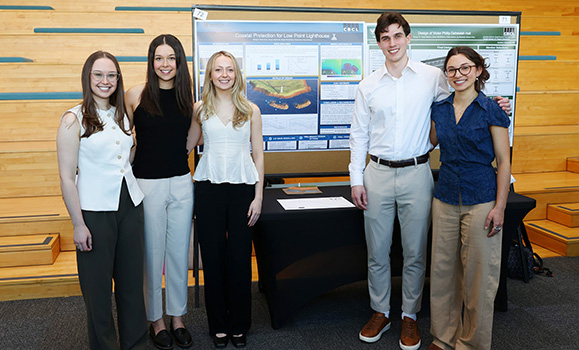
Abigail Mendel-Elias, far right, and her teammates. (Submitted photo)
That restriction quickly ruled out what would normally be the simplest solution. Abigail says a rock revetment, which reinforces the shoreline with layers of rock to slow erosion, would have been the easiest approach.
“But you can’t design a revetment if there’s endangered birds nesting there,” she adds.Ěý
That limitation ultimately led the team to pursue a breakwater, an offshore structure designed to reduce wave energy before it reaches the shoreline, and a far more complex engineering design.
Design process
Designing that breakwater required much more than a single solution. Before settling on a final approach, the team developed multiple design options, running detailed analysis to compare performance, cost, and feasibility.
Much of that work was driven by data. The team carried out extensive modelling to understand how waves interact with the shoreline and used advanced tools to simulate how different designs would perform under a range of conditions.
“Most of the groundwork for the final design process was in the first semester,” says Abigail. “And it was a lot of work that we had never done before.”Ěý
It’s exactly the kind of challenge that capstone projects are designed to deliver, pushing students beyond textbook problems and into unfamiliar territory.
“It was much more research-based than anything we’d done in class,” says Abigail. “Instead of being given a framework, we had to rely on technical resources and figure out which methods and equations best fit the conditions ourselves.”
Instead of being given a framework, we had to rely on technical resources and figure out which methods and equations best fit the conditions ourselves.
Their result was a construction-ready design that balanced technical detail with the realities of building in a complex coastal environment.Ěý
The team’s efforts, while not being implemented by CBCL, did not go unnoticed. At this year’s Capstone Conference presentations, their project was named the top civil engineering project, placing first among all civil engineering teams.Ěý
For Abigail however, the experience was just as much about collaboration as it was about engineering.
“I learned how nice it is to work in a group that actually functions well,” she says. “We really divided the project in a way that made sense, and everyone played to their strengths.”
(Top photo: )