

Heard of OpenThink? Sure, but not like this.
Fifteen PhD students from nine faculties across ±«Óătv are the newest members of the university’s annual OpenThink program, designed to help them share their research beyond academia to influence public conversations and policy.
And this year, they’re shaking things up.
Traditionally, OpenThinkers have published monthly posts on the . While readers can still expect to learn about intriguing topics this way, this year’s cohort will explore brand-new formats for knowledge mobilization throughout the year — from podcasting to Instagram Reels.
"OpenThink is all about meeting audiences where they are," says Kala Clarke, senior manager, professional development and student engagement with ±«Óătv's Faculty of Graduate Studies.
OpenThink is all about meeting audiences where they are.
"This year is an opportunity for the students to experiment with different ways of communicating and figure out what resonates most with their research topic and the people they're trying to reach."
Along with the new formats, this year’s cohort is introducing new research backgrounds, including a student joining from the PhD Management Program for the first time. Throughout the year, OpenThinkers will cover a series of topics that span across disciplines, from investigating heat generation in lithium-ion batteries to improve safety and lifetime, to using fruit flies to study how muscles repair themselves after repeated movement.Ěý
"Right from OpenThink’s start in 2020, ±«Óătv’s PhD students have offered up a diverse array of cutting-edge insights for the public. Our 15 newest OpenThinkers will be covering some exciting topics as they join their ranks," says Dr. Lynne Robinson, academic director of OpenThink.
Dr. Christian Blouin, dean of the Faculty of Graduate Studies, says while researchers are training to advance knowledge by communicating with peers, the work's real value is in making a difference in society.
"Being able to communicate the great things that we do is both grounding for researchers, but also a critical means of advocacy for publicly funded research. OpenThinkers are at this frontier and Dal is cheering them on," he says.
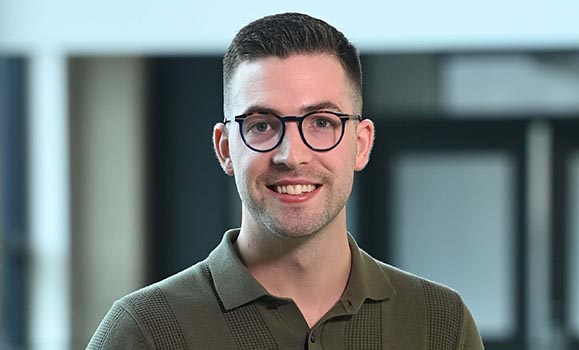
For Noah Doucette, PhD candidate in nursing, the program offers a platform to promote equitable and inclusive human papillomavirus (HPV) vaccination. We caught up with him to discuss his research and how OpenThink will help him make it accessible to more people.
 Ěý
Ěý
Tell us about the research you’ll be exploring throughout the year as an OpenThinker.
Throughout my contributions to OpenThink, I hope readers and listeners will be able to learn more about the importance of HPV vaccination, potentially recognizing what HPV might mean for their (or their loved ones’) health and well-being. The main message that I hope people will take away from my work is that HPV does not discriminate, and by sharing accessible vaccine-related information, more people might be able to experience the benefits of prevention.
Why is your research important right now?
HPV can cause many adverse health outcomes, including six different types of cancers and genital warts in both males and females. Much of what people know about HPV is in relation to women and cervical cancer prevention. However, fewer people know that throat cancers are now the most common HPV-related cancer in Canada, with many new diagnoses occurring in men. My research aims to explore potential opportunities to make public health messaging about HPV vaccination more inclusive, so that everyone can make informed decisions about whether or not the vaccine is right for them.
What drew you to your topic?ĚýĚý
Having known nothing about the infection prior to experiencing an HPV-related health condition, my lack of understanding about the infection is what drew me to this area of public health research. Specifically, through research, I want to make sure that more people understand HPV as much larger than a “women’s health issue”, helping them potentially benefit from the prevention of penile, anal, vaginal, vulvar, cervical and throat cancers, as well as genital warts. As a member of the men who have sex with men (MSM) community, this population is one group that I hope my research will be able to help. MSM experience disproportionately higher rates of HPV-related infections and associated diseases, but vaccine uptake remains suboptimal.
A key part of OpenThink is making research accessible beyond academia. What kind of difference do you hope your work will make?
OpenThink’s commitment to making research accessible beyond academia was my main motivator for joining this year’s cohort. Using my time as an OpenThinker to educate more people about the importance of HPV vaccination is one example of bringing public health research to life so that it can positively influence the health and well-being of many. Ultimately, as part of the OpenThink community, I hope my work will be able to gain visibility by people who might not know a lot about the infection, which I believe is necessary for contributing to the elimination of potentially preventable HPV-related infections and associated diseases in Canada and worldwide.Ěý
Where do you see your research going in the future? How do you think OpenThink will help shape this?
I believe that my time as an OpenThinker will profoundly shape the rest of my PhD journey and future aspiring career in academia. Specifically, I hope to build foundational skills in translating research with non-academic audiences, making complex public health information more accessible and inclusive to diverse groups, and engaging like-minded individuals, both academic and community-based, who can help realize the change I wish to see — more equitable and inclusive HPV prevention.